The Challenge of Specialty Crops
While broadacre crops like wheat and corn have been mechanically harvested for decades using massive combine harvesters, specialty crops—such as strawberries, tomatoes, apples, and asparagus—have heavily relied on manual human labor. These crops are highly susceptible to bruising, require selective picking based on ripeness, and grow in complex spatial arrangements that confound traditional machinery.
Harvesting robots represent the engineering effort to bridge this gap. By combining soft robotics, dynamic articulation, and advanced optical sensors, developers are creating machines capable of mimicking the dexterity and decision-making capabilities of a human picker.
Vision Systems and Ripeness Detection
The most critical component of a harvesting robot is its vision system. A robot cannot pick what it cannot clearly identify. Modern units employ stereoscopic cameras and multispectral imaging to scan plant canopies continuously.
The software running these cameras utilizes deep learning algorithms trained on thousands of images of fruit in various stages of maturity. The system must not only identify the fruit but also calculate its 3D coordinates, assess its color for ripeness, and determine if there are any obstructions (like leaves or branches) in the robotic arm's path. This entire computational process must occur in milliseconds to maintain a commercially viable picking speed.
End-Effectors and Soft Robotics
Once a fruit is identified and targeted, the physical extraction is handled by the "end-effector"—the robotic equivalent of a hand. The design of the end-effector varies wildly depending on the crop:
- Vacuum Systems: Used primarily for apples and citrus, these effectors use gentle suction to pull the fruit into a padded tube without applying mechanical pressure to the skin.
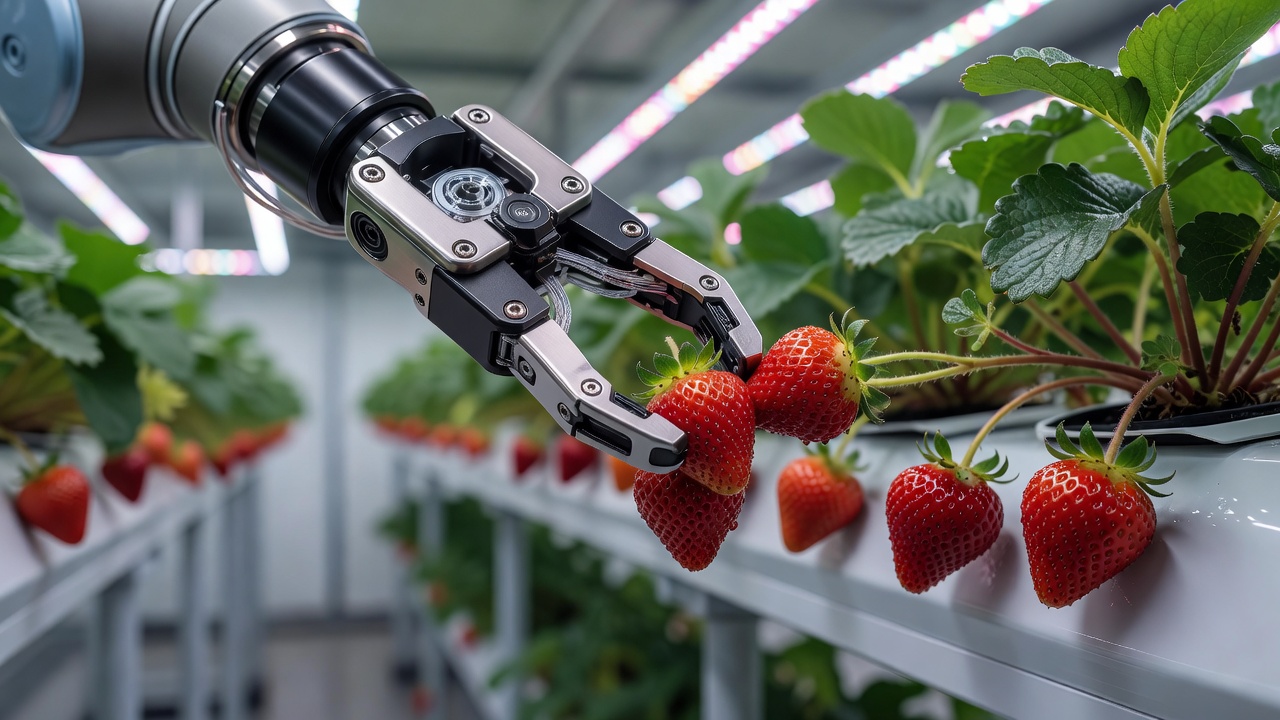
- Silicone Grippers: Soft, pneumatically actuated fingers that wrap around delicate items like strawberries, applying just enough pressure to grip but not crush.
- Scissor and Pluck: Mechanisms that locate the stem and cleanly cut it, allowing the fruit to drop into a catching mechanism, commonly used for vine crops like tomatoes.
Environmental Adaptability
Unlike a controlled factory floor, an agricultural environment is highly dynamic. Harvesting robots must function in varying light conditions—from glaring midday sun to artificial greenhouse LEDs. They must withstand high humidity, dust, and uneven terrain.
Many of the most successful early deployments of harvesting robots have occurred in controlled environment agriculture (CEA), such as modern glasshouses. In these environments, the crop presentation can be standardized. For example, strawberry tables can be hung at an exact height, allowing the robots to navigate smooth concrete floors and operate in uniform lighting, vastly simplifying the engineering parameters.
Economic and Labor Implications
The drive toward harvesting robots is primarily economic, spurred by a critical shortage of seasonal agricultural labor in many developed nations. When crops cannot be picked in time, they rot in the field, leading to total yield loss for that section.
While the initial cost of a harvesting robot is high, it provides predictability. Farm operators can calculate a fixed cost per kilogram harvested, free from the variables of minimum wage fluctuations, worker housing logistics, and seasonal availability. Furthermore, because robots can operate at night with artificial lighting, they can harvest crops when temperatures are cooler, which naturally extends the shelf life of the produce before it even reaches the packing facility.
Current Limitations
Despite rapid advancements, harvesting robots still struggle to match the raw speed of a skilled human picker. Humans possess an innate ability to gently push aside foliage and quickly locate hidden fruit—a task that requires immense computational power for a robot to perform safely. The current generation of robots serves best as a supplementary workforce, tackling the bulk of the accessible harvest while human workers handle complex clusters or heavily occluded fruit.